
Counter‑recruitment in the United States has never been a static practice. It has evolved across generations, shaped by war, policy, youth culture, and the shifting forms of militarism that permeate American life. To understand how counter‑recruitment became a movement — and when it reached its peak — we must trace its development across five decades of conflict, dissent, and organizing. This is not simply a story about opposing military enlistment. It is a story about youth agency, community defense, and the struggle to define what futures are possible for young people in a society that has repeatedly turned to war as a solution.
I. Origins: The Vietnam Era and the Birth of Youth Resistance
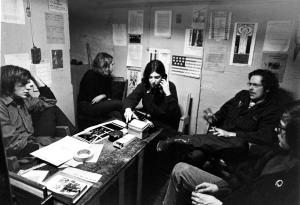
Members of the Toronto Anti-Draft Programme, a war resisters’ group opposed to the Vietnam War, counsel Americans over the phone on how to evade the draft. Spadina Avenue, Toronto, Canada, August 1967.
The Vietnam War created the first mass challenge to U.S. military manpower policy. Draft resistance, GI organizing, and anti‑war student networks formed a powerful ecosystem of dissent. Young people confronted not only the war itself but the machinery that fed it: conscription, propaganda, and the moral pressure to serve. Draft counseling centers, underground newspapers, and GI coffeehouses became hubs of resistance. These efforts were not yet called “counter‑recruitment,” but they laid the intellectual and moral foundation for it.
The focus of the era was resisting the draft, not voluntary enlistment. Recruitment was certainly contested — especially in communities targeted by military recruiters — but the central fight was against compulsory service. When the draft ended in 1973, much of the infrastructure that had supported youth resistance dissolved. Without the urgency of forced service, counter‑recruitment remained scattered, local, and overshadowed by other social movements. Yet the Vietnam era left behind a crucial legacy: the idea that young people have the right to question militarism and refuse participation in war.
II. The Quiet Reconstruction: 1980s–1990s Legal Battles and School Access
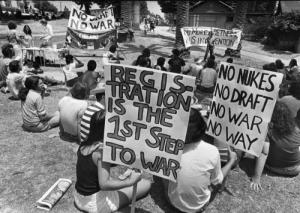
[Picket sign in Los Angeles on the first day of renewed draft registration, 21 July 1980: “Registration is the 1st step to war”. Photo by Dean Musgrove from the Herald Examiner Collection, L.A. Public Library.]
The 1980s and 1990s were a quieter but essential period in the development of counter‑recruitment. As the military shifted to an all‑volunteer force, recruitment became more aggressive, more sophisticated, and more deeply embedded in public schools. Recruiters gained routine access to campuses, career fairs, and student data. They became fixtures in hallways and cafeterias, often without scrutiny.
In response, small groups of educators, peace activists, and civil liberties advocates began challenging these practices. Their work was procedural, legalistic, and often invisible to the broader public. They fought for equal access policies, argued for the right to present alternatives to military service, and pushed back against the normalization of military presence in schools. A landmark 1986 Ninth Circuit ruling affirmed that counter‑recruiters had the same right to speak to students as military recruiters, establishing a legal foundation that would later prove essential.
These decades also saw the emergence of early training materials, pamphlets, and school‑based workshops that explained enlistment contracts, recruiter tactics, and the realities of military life. Though modest in scale, this work built the scaffolding for what would become a national movement. By the late 1990s, however, counter‑recruitment had lost momentum. The Gulf War had been brief, the economy was strong, and militarism had become largely invisible to many Americans. Recruitment continued to expand in schools, but organized resistance remained limited.
III. The Post‑9/11 Surge: Counter‑Recruitment Becomes a Movement
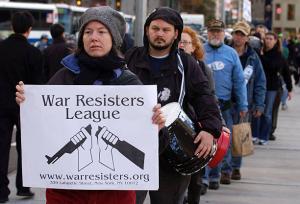
Protestors March Against War After Election
NEW YORK - NOVEMBER 3: Protestors from the War Resisters League march against war the day after the U.S. presidential election November 3, 2004 in New York City. The protesters marched from Ground Zero to the New York Stock Exchange. (Photo by Bryan Bedder)
The attacks of September 11, 2001, radically altered this landscape. As the United States launched wars in Afghanistan and Iraq, military recruitment intensified. The passage of the No Child Left Behind Act forced schools to provide student contact information to recruiters and guaranteed them access to campuses. Suddenly, militarism was not only visible but unavoidable, especially for young people in under‑resourced districts. Recruiters appeared in cafeterias, hallways, and classrooms. They called students at home. They targeted communities facing economic hardship, promising stability, education, and opportunity.
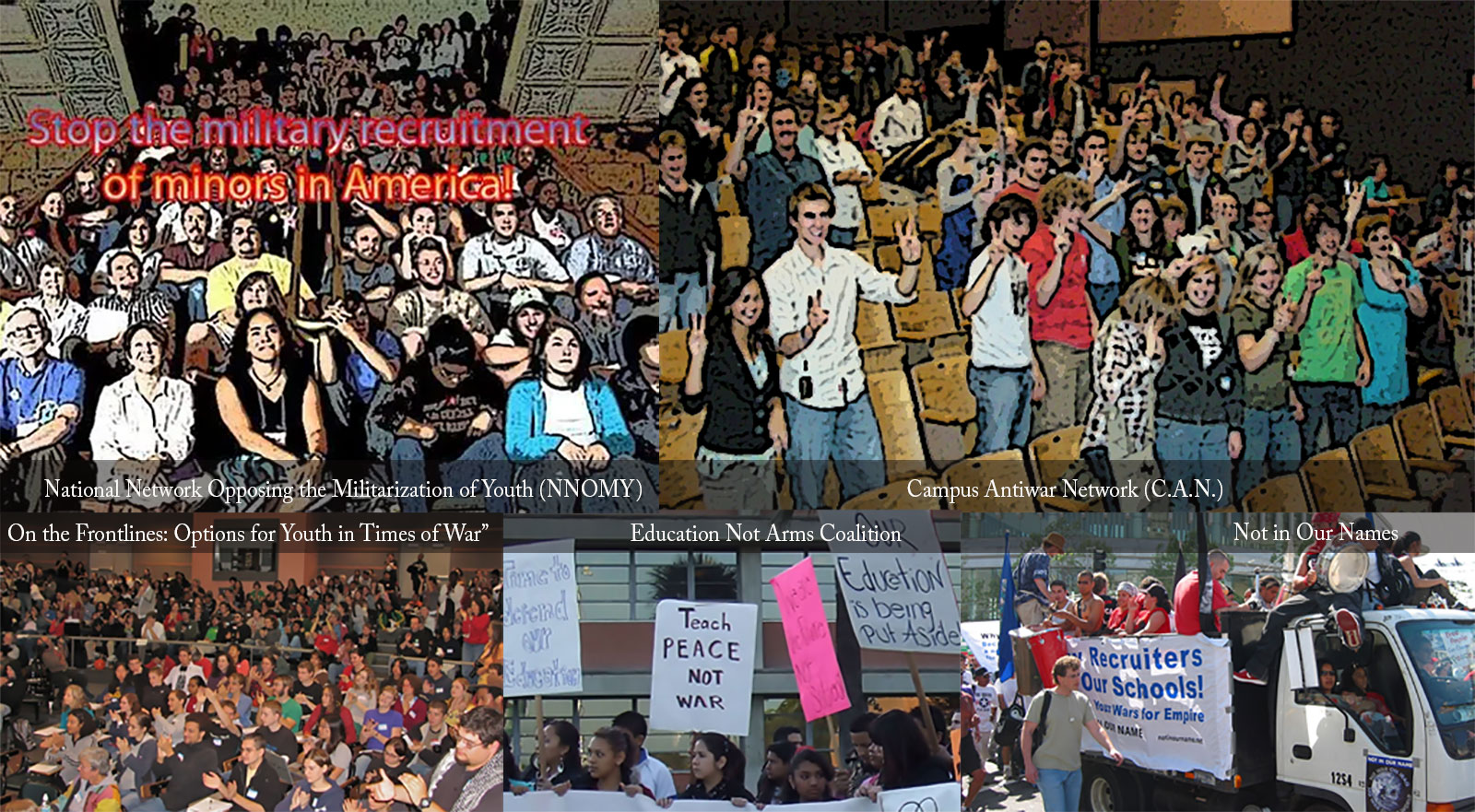
It was in this context that counter‑recruitment surged into a national movement. What had once been a scattered set of local efforts transformed into a coordinated, multi‑organizational network. Groups such as the American Friends Service Committee, the War Resisters League, and dozens of regional coalitions began sharing strategies, training materials, and legal resources. In 2003, organizers convened a national conference that brought together more than 150 activists. A second conference in 2004 drew similar numbers, signaling that counter‑recruitment had become a recognized field of organizing. The formation of the National Network Opposing the Militarization of Youth (NNOMY) provided a central hub for coordination, communication, and national strategy.
Between 2001 and 2009, counter‑recruitment reached its peak. Activists challenged recruiter access in schools, organized opt‑out campaigns to protect student privacy, and exposed the realities of enlistment contracts and military life. They confronted the expansion of Junior ROTC programs, documented recruiter misconduct, and trained youth to understand the moral and political dimensions of militarism. Counter‑recruitment became not merely anti‑war work but a form of youth empowerment, educational justice, and community defense. It offered young people — especially those in marginalized communities — a critical lens through which to understand the forces shaping their futures.
The movement’s scale during these years was unprecedented. By 2009, a national conference brought together roughly 300 organizers from across the country, the largest gathering in the history of counter‑recruitment. The work was diverse, ranging from legal advocacy to street theater, from classroom presentations to community workshops. Counter‑recruitment became a recognized component of the broader peace movement, with its own identity, infrastructure, and national reach. It was a moment when youth empowerment, anti‑militarism, and educational equity converged into a coherent, powerful force.
IV. Fragmentation and Transition: 2010s–Present

In recent years, the military services have expanded their outreach methods to include presences on esports streaming platforms, using them as a recruiting tool to reach youth and educate them on military service.
After 2010, the movement entered a period of fragmentation. As public attention shifted away from the wars and recruitment increasingly moved online, school‑based activism lost some of its urgency. The military adapted quickly to digital platforms, using social media, gaming environments, and algorithmic targeting to reach young people. Counter‑recruitment, rooted in face‑to‑face school organizing, struggled to keep pace. National coordination weakened, and many local groups lost funding or dissolved. The movement did not disappear — but it no longer operated at the scale or intensity of its peak years.
Today, counter‑recruitment faces a transformed landscape. Militarism has become more diffuse, more technological, and more embedded in everyday life. Junior ROTC programs have expanded dramatically, often without parental consent. Recruitment increasingly targets youth through esports, influencer culture, and data‑driven marketing. The political climate has grown more tolerant of militarization, even as enlistment numbers decline. Counter‑recruitment must now confront not only the presence of recruiters in schools but the broader cultural and digital systems that shape youth identity and opportunity.
V. The Future: Reimagining Counter‑Recruitment for a New Era
The lessons of the movement’s peak remain vital. The early 2000s demonstrated that counter‑recruitment can become a powerful national force when organizers connect youth empowerment, educational equity, and anti‑militarism into a shared narrative. The challenge today is to adapt that legacy to new conditions — to rebuild a movement capable of meeting militarization where it lives now, whether in classrooms, algorithms, or cultural institutions.
Counter‑recruitment’s history shows that resistance to militarism is strongest when it is rooted in community, grounded in youth agency, and connected to broader struggles for justice. Its future will depend on whether organizers can once again transform scattered efforts into a coherent movement, capable of confronting the evolving forms of militarization that shape the lives of young people.
NNOMY | 2026
###