 11/29/2-14 / Henry St. Maurice / Village Voice - As someone who volunteered for alternative service during the era of the war in Southeast Asia, I have strong opinions about militarism. I am sure that armed forces are not the only kind of service to one’s country, even though most of my fellow citizens grant that status by referring to military service as “the service.” In greeting my first classes each semester I taught as a teacher educator, I asked for a show of hands by veterans of military service, and thanked them. I then asked for a show of hands and thanked returning members of the Peace Corps or Americorps. I think that my country would be better served if young people were given choices of howto serve, and thereby acquire skills and benefits now reserved for those who bear arms. Selective Service, which now requires registration only by males, could become a means of national service to help communities and alleviate epidemic unemployment among citizens aged eighteen to twenty-five.
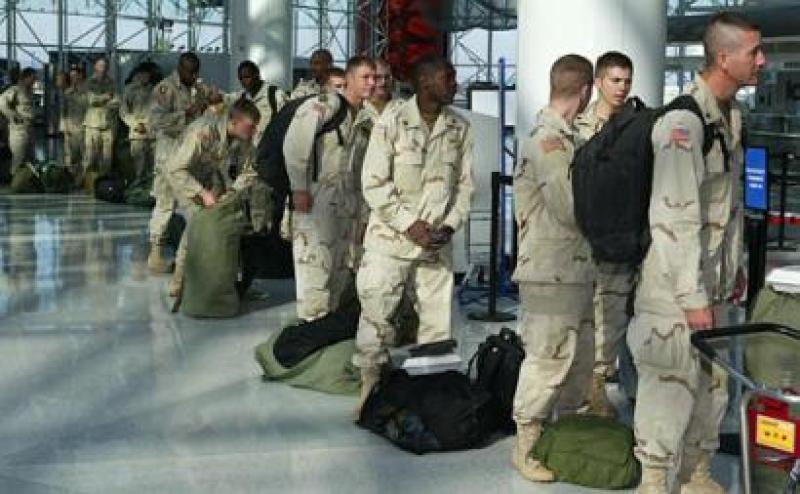
My opinions were tested recently when my twelve-year old daughter,seeing soldiers in fatigues in an airport, turned to me and said excitedly, “Isn’t it cool! They just got back from serving in Iraq or Afghanistan!” Much as I was pleased that she was up on current events, I had to think for a long moment before I responded, “Yes, they are soldiers, and may have been there. There are many others who serve their country who aren’t dressed like that.” In that second sentence I tried to be fair, but couldn’t avoid sounding pedantic. That moment reminded me how often parents and educators must deal with situations like those.
In my state, I have been involved in distributing materials about alternatives to militarism at conferences for counselors. Our group usually runs out of handouts after a day on the exhibit floor. Our exhibit sits next to those run by college and military recruiters, who often come over to chat or look at our display, as we do to theirs. Occasionally, we’ll get a sour look, and even a few e-mails condemning our exhibit as unpatriotic. Those responses just harden our determination to stand up to the juggernaut of militarism in our nation, especially in the decade after 9/11/01. Despite the waste and futility of wars in the Middle East, militarism’s true believers cling to their beliefs, getting aid and comfort from media besotted with images ofcombat as a video game, and vice versa.
This article is for educators who have kept open minds about militarism, and every day are engaged in discussions like the one I had with my daughter. Listed below are sources that we have found useful in our work; they are as current as possible. If any readers find errors or omissions in these sources, please contact me. All links listed below are official ones; an Internet search entry would yield a pile of unofficial ones.
- Community service is an option. Americorps enrolls more than 85,000 young people who can serve learn and earnafter high school. Peace Corps is a great option for those who choose to serve overseas after college.
- In most states, some youth internships are available, as are apprenticeships. In my state of Wisconsin they are listed by the Department of Workforce Development.
- The American Friends Service Committee has been opposing militarism for nearly a century. Their publication for youth in high school, entitled, “It’s My Life,” is a free downloadable source of information and opinion; a copy should be in every adolescent’s school and home.
- The National Network Opposing the Militarization of Youth is an activist group that helps schools and parents organize.
- The War Resisters League has a good manual entitled DMZ: Demilitarized Zone, aimed at those who plan to take group action.
- The Armed Services Vocational Aptitude Battery (ASVAB) is a military recruiting tool as well as a test. It is mandatory in many high schools, despite an opt-out provision being available. Find out whether your school allows students to opt out, by contacting the National Coalition to Protect Student Privacy and the Rogue Valley Peace Veterans.
- In my days as a teacher of high-school English, I made sure to include on my syllabi Dalton Trumbo’s Johnny Got his Gun as an antidote to Stephen Crane’s Red Badge of Courage and other novels that glamorize militarism. One parent, who was himself a veteran, read Trumbo’s novel when I had assigned it to his son’s class, and told me that, “It tells it like it is.” Two classic (i.e., old) movies that I liked to show in my classes on cinema were also set in the so-called Great War: All Quiet on the Western Front and Grand Illusion. I’d always wait a few seconds before tuning the lights back on, because adolescents don’t like to be seen weeping. In discussions of these and other media, someone usually interjects that, unlike shooter games, no one gets more lives in combat. That’s a thought also worth having while watching commercials for military services.
- For a current list of these and other sources particular to Wisconsin, go to Truth About Militarism in Education (T.A.M.E.)
The greatest resource is knowledge that many others believe in ways to peace and justice beyond and without military force. At the time that I applied for alternative service, my favorite conscientious objector was – and remains - Muhammad Ali. I was also inspired by John F. Kennedy, who once said, “War will exist until the distant day when the conscientious objector enjoys the same reputation and prestige as the warrior does today” (source cited in note #44 at http://en.wikipedia.org/wiki/Conscientious_objector ).
These resources are meant to bring that distant day closer. My daughter has yet to ask me about my experience as a conscientious objector. I’ll be ready when she does.
Please consider supporting The National Network Opposing the Militarization of Youth
and our work to demilitarize our schools and youth by sending a check to our fiscal sponsor "in our name" at the
Alliance for Global Justice.
Donate Here
###
Revised: 02/05/2024 GDG