 July-September 2022 / Lauren Reyna Morales / Draft NOtices - In the summer of 2020, I was recruited by the non-profit Project on Youth and Non-Military Opportunities (Project YANO) to review core textbooks used by the U.S. military in the high school Junior Reserve Officers Training Corps (JROTC) program. Project YANO organized a team of 15 reviewers that consisted of individuals with backgrounds in either classroom teaching or education activism, or with special knowledge of subjects that JROTC claims to address in its curriculum (e.g., U.S. and world history, geography, leadership methods, etc.).
In total, eleven Army, Navy, and Marine Corps JROTC texts were reviewed. The reviewers included current and retired teachers, military veterans, and several educators with post baccalaureate credentials. I myself have been a classroom teacher for five years. I’m credentialed to teach English and Social Sciences in the state of California, and I also earned an M.A. in education from the University of Colorado, Denver. I personally reviewed an Army JROTC textbook titled, Leadership Education and Training (LET 3). I was eager to investigate the kind of curriculum JROTC utilizes to influence over 550,000 students at approximately 3,400 high schools. What, I wondered, is the U.S. military teaching to youth in their places of learning?
What I found inside the JROTC Army text I reviewed was awful. I’m not sure how any educator could review this textbook and give it a positive evaluation: at best, it is a compilation of stunningly deficient and problematic lessons. My assessment, however, is not nearly as passive nor forgiving. Broadly speaking, I found that the LET 3 text actively supports Eurocentrism and white supremacism by way of the values, concepts, and narratives that it enforces. The text also intentionally promotes the suppression of critical thinking and consciousness. Furthermore, it seriously fails to provide an accurate representation of what service in the military is like and does not give sufficient resources for students to explore other options for themselves.
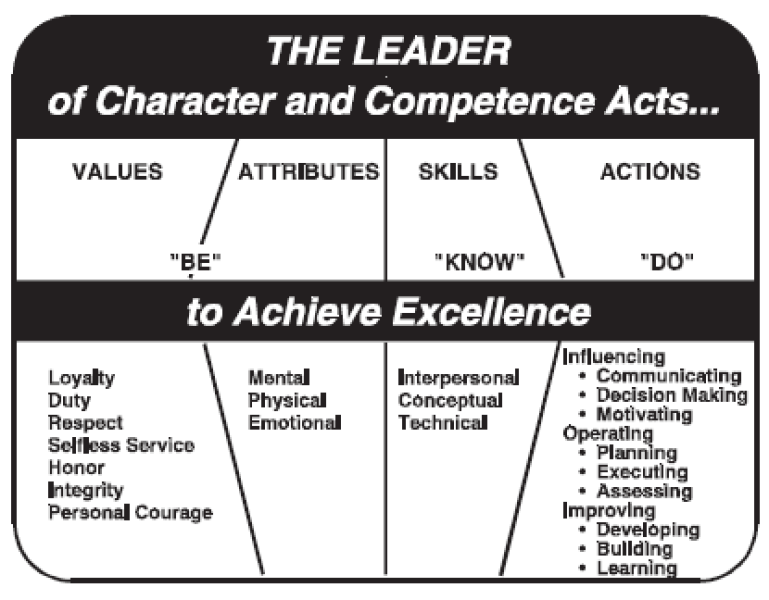
As professed in its title and contents, LET 3 positions itself as a curriculum that educates and trains students how to become leaders. This “leadership education” training is methodically instructed through the lens of the military’s model, which the curriculum perpetually conflates with how one ought to view leadership in the civilian realm. The entire text revolves around sanctifying “the chain of command,” as it relates to what makes a team function and a human being successful in supporting the greater good. In effect, this curriculum incessantly upholds the value of blindly following orders from “superiors” and demonizes engaging in any type of critical thinking. All of which directly refutes the values students ought to be learning at school. In contrast to JROTC’s values, it is the moral duty of educators to foster in youth the capacity for analytical contemplation and the ability to discern the best course of action for themselves.
Among the things that most struck me about the textbook are the disturbing “explanations” it offers of racial and ethnic relations in the United States. For example, the chapter “Celebrating Differences — Cultural and Individual Diversity” opens its first lesson by posing a Star Trek analogy to begin “teaching” about this topic. The text asserts that “each individual is unique and you must value that uniqueness, just like Captain Kirk and his crew did.” From here, the lesson continues on to superficially stress the importance of valuing the differences amongst people in society today. The text celebrates the U.S. as being the most “diverse nation in the world,” but utterly fails to mention it is also among the most racially-divided in terms of education, housing, and healthcare. Nowhere in this chapter, or in the entirety of the textbook, is there an attempt to historically contextualize how U.S. society has become so marked by oppression amongst minoritized and marginalized peoples. The text instead assumes the dangerous position that “prejudice” against others is natural, reducing the concept to a mere preference and something detached from societal conditioning and systematic enforcement. LET 3 utterly fails to address how racism, discrimination, and deep inequities exists in all factions of our society by deliberately withholding the foundational history of the U.S. It is abhorrent to suggest that this curriculum would provide any “leader” with the tools necessary to promote healthy diversity and inclusion of all peoples within a military or civilian setting.
JROTC claims that the program is not set up to channel students directly into the military. This is hard for me to believe. I say this because the curriculum downplays the widespread discriminatory practices historically and presently upheld by military institutions. For example, the text only dedicates a mere few sentences to the fact that the institution was completely segregated until Executive Order 9981 was signed by Harry Truman. LET 3 also omits the policies that have directly targeted LGBTQ members, and neglects to represent the pervasive sexual abuse that happens within the military. Lastly, the text does not speak to the very real consequences that may arise from military service (emotional trauma, physical injury, and death, to name a few).
Education can be transformative to the lives of students; it has the potential for liberation but also for great harm. I am invested in teaching youth because the exploration of narratives (historical and otherwise) has the power to disrupt oppressive power structures that are pervasively enforced by systems in the U.S. The curriculum used in JROTC is not just inadequate, it is detrimental and directly contradicts the moral responsibility educators have. All students deserve to learn the full and true history of the United States, especially as it relates to explaining the vast disparities that exist in this country for minoritized and marginalized groups. Actively withholding this information is a political tool for maintaining white supremacist narratives. Students should be encouraged to think critically and discern for themselves. Youth deserve an accurate representation of the destructive and racist foundation the military institution was built upon, as well as the terrible consequences that can arise from joining it. The JROTC “curriculum” effectively reads as propaganda more than a viable educational tool.
To download the complete JROTC textbook review, visit http://projectyano.org/index.php/literature-and-resources/jrotc/70-jrotc-textbook-review
Source: https://www.comdsd.org/index.php/articles-archive/269-what-i-discovered-in-the-jrotc-curriculum-2
Please consider becoming a $10 per month supporter of The National Network Opposing the Militarization of Youth
And our work to demilitarize our schools and youth.
Donate Here
###