
Home
National Network Opposing the Militarization of Youth (NNOMY)
  • Home
  • Community Action
    • Parents
    • For Teachers/Guidance Counselors
      • Start a Peace Club
    • Students
    • For Enlisted Personnel and Veterans
  • School Militarization
    • Education as Enforcement: Militarization and Corporatization of Schools
    • Facts About Recruiting
    • School Policies
      • JROTC Shooting Ranges, San Diego, CA
    • ASVAB
    • DOD Starbase
    • DOD STEM
    • Joint Advertising Market Research Studies (JAMRS)
    • JROTC
      • Chicago has multiple military academies converted from public schools
    • Young Marines
  • Counter-recruitment
    • Demilitarization Groups & Info
    • Peaceful Careers
    • Say No to the Solomon Amendment? The Movement Hasn't Disappeared
    • The Long Arc of Counter‑Recruitment: From Vietnam-Era Resistance to a National Movement
    • Religious Objection to War
    • Truth In Recruiting
    • Voices of Military Experience
      • Recruitment abuses and coercion
      • Abuses Within Military Service
      • Aftermath & Post‑Service Consequences
      • Resistance, Healing & Recovery
    • How can NNOMY increase its outreach?
  • Resources
    • Academic Articles
    • Books
    • Campaigns & Projects
    • Music against war
    • News Reports
    • Publications
    • Social Media
    • Video
      • Counter-recruitment
        • Campaigns & Project Videos
        • National & Regional Groups
        • Counter-recruitment training
        • Resistance to Militarism
      • Military Contamination
      • Military Recruitment
        • JROTC
        • Military Recruitment in Poor High Schools
      • Violent Gaming and Militainment
        • Militarization of the Media
  • About
    • Steering Committee & Staff
    • NNOMY 2003-2026
  • Donate

English
  • English
  • Español
  1. Home

Football, the military and one Florida high school student’s difficult choice

Thu, 12/11/2014 - 3:22pm by nnomyadmin

Football, the military and one Florida high school student’s difficult choice


Kent Babb -

MONTICELLO, Fla. — The binder sat open on his adoptive mother’s lap, turned to the page where the scholarship papers lay in a transparent sleeve.

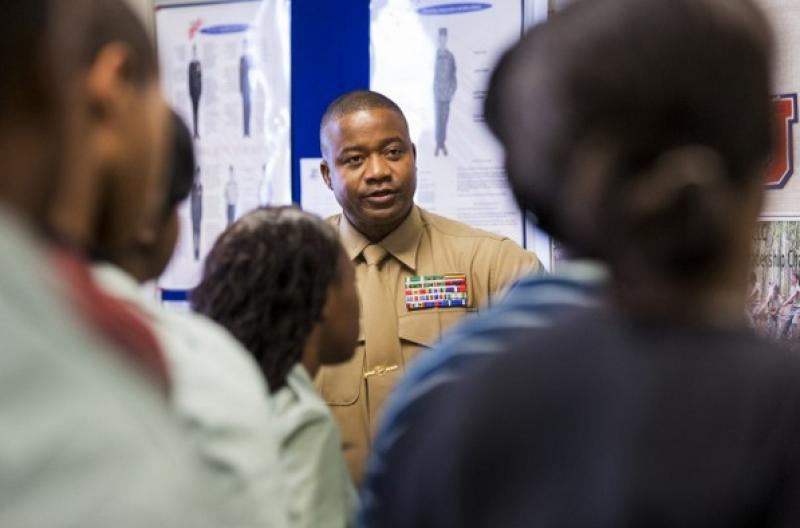
JROTC instructor talks to students in impoverished Florida panhandle communityNik Branham said nothing, holding the phone in its camouflage case close enough that his face glowed. The woman supported her 17-year-old’s plan to join the Army, but she didn’t understand it. These papers were a miracle, as she saw it, college at least partially paid for because of the hell he had survived, a chance at an education and maybe a few more years of football, the game he once loved.

“I done explained everything,” said Alice Branham, a foster parent who adopted Nik and his older sister Ambrosia six years ago, and when the process was complete the state of Florida offered the “Road to Independence” scholarship. In the time since, Alice had come to love him, to become inspired by his confidence and also frustrated by it, to refer to him as a “pit bull”: Once he sank his teeth into a decision, he wouldn’t let go.

“Nobody can change my mind,” he said, and Alice looked away.

In the South, like most parts of the United States, football and the military are cultural siblings — two powerful and venerable forces, brought together week after week for the crowds and cameras. There are anthems and flyovers, shared terminology like “formations” and “blitzes,” pride in home teams and service branches passed through the generations like precious heirlooms.

But beyond the bright lights and choreography, these grand American institutions face frequent and, often shared, criticism: that both are overgrown and unnecessarily powerful, that players and soldiers are trained for games and combat but rarely are prepared for a return to normal life, that football and military recruiters sell a glamorized version of reality — rarely mentioning the shared risks of long-term brain injuries, psychological disorders and a shortage of post-career support.

In Jefferson County, this mostly rural and increasingly poor area in the Florida Panhandle, young people are drawn to the glory, sure, but many of them see football and military service as something more fundamental: a way out. Indeed, surveys have shown Jefferson County — nearly 19 percent of the roughly 14,200 residents here live below the poverty line — as a high per-capita producer of both college football talent and military recruits. An audit of 2013 college football rosters by Mode Analytics found that about one in every 83 boys left the county to suit up for a college team. “We’re definitely a tougher breed,” said DeVondrick Nealy, a Monticello native who’s now an Iowa State running back. -
Read More...


··

Revised 04/25/2016

School Militarization
Military recruiters
Public Schools
Military recruitment

What Every Young Woman Should Know About the Military

What Every Young Woman Should Know About the Military

A Brochure for Young Women Thinking About Joining the Military | 2022

"When I joined, I knew that women in the military faced an uphill battle, but I didn't fully understand how serious the issues were and how reluctant leadership is to doing anything about it.

The truth is that there's a culture of harassment and assault that is incredibly harmful to all troops, but especially to gender minorities."
Brittany Ramos DeBarros
 

Brochure - 30Mar22 Ver (w bleed).pdf

Download PDF

Skip to main content

Get email updates

Manage my subscriptions

Follow us

Mastodon 
BlueSky 
Instagram 
Facebook 
LinkedIn 
Twitter 

Donate

Please consider supporting our work with a tax-deductible donation.

Donate

Powered by Backdrop CMS