
español -
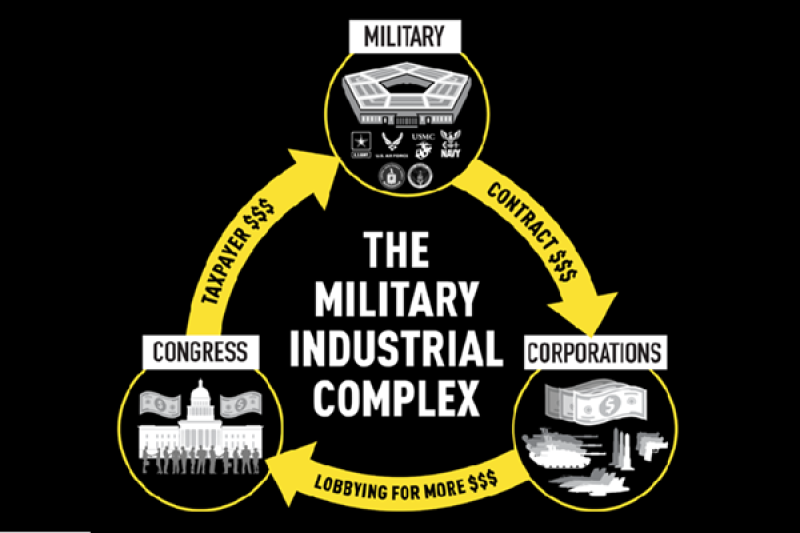
 July 18, 2025 / Nolan Higdon & Sydney Sullivan / CounterPunch - During President Donald Trump’s second term, education has remained a central battleground in American politics. Republicans claim that classrooms have become hotbeds of “woke” indoctrination, accusing educators of promoting progressive agendas and tolerating antisemitism. In contrast, Democrats argue that conservatives are systematically defunding and dismantling public and higher education precisely because it teaches values like diversity, equity, and inclusion. While these partisan skirmishes dominate headlines, they obscure a much deeper and more enduring issue that encompasses all of these issues and more: the influence of corporate and military power on public education.
For decades, scholars have warned that corporations have steadily infiltrated the classroom—not to promote critical thinking or democratic values, but to cultivate ideologies that reinforce capitalism, nationalism, and militarism. Critical media literacy educators, in particular, have called attention to the convergence of tech firms and military entities in education, offering so-called “free” digital tools that double as Trojan horses for data collection and ideological control.
One striking example is the rise of programs like NewsGuard, which uses public fears over fake news to justify increased surveillance of students’ online activity. Relatedly, in 2018, the Atlantic Council partnered with Meta to perform “fact-checking” on platforms such as Facebook. In 2022, the US Marine Corps discussed developing media literacy trainings. It remains to be seen what training, if any, they will develop. However, what is known is that a large global player has entered the media literacy arena: the North Atlantic Treaty Organization (NATO). While NATO presents its initiatives as supportive of media literacy and democratic education, these efforts appear to be oriented more toward reinforcing alignment with its strategic and political priorities than to fostering critical civic engagement.
NATO was created in 1949, during the Cold War, as a military alliance to contain communism. Although the war officially ended in 1991, NATO has expanded both its mission and membership. Today, it encompasses more than thirty member nations and continues to frame itself as a global force for peace, democracy, and security. But this self-image masks real conflicts of interest.
NATO is deeply intertwined with powerful nation-states and corporate actors. It routinely partners with defense contractors, tech firms, think tanks, and Western governments—all of which have a vested interest in maintaining specific political and economic systems. These relationships raise concerns when NATO extends its reach into education. Can a military alliance—closely linked to the defense industry and state propaganda—credibly serve as a neutral force in media education?
In 2022, NATO associates collaborated with the US-based Center for Media Literacy (CML) to launch a media literacy initiative framed as a strategic defense against misinformation. The initiative included a report titled Building Resiliency: Media Literacy as a Strategic Defense Strategy for the Transatlantic, authored by CML’s Tessa Jolls. It was accompanied by a series of webinars featuring military personnel, policy experts, and academics.
On the surface, the initiative appeared to promote digital literacy and civic engagement. But a closer look reveals a clear ideological agenda. Funded and organized by NATO, the initiative positioned media literacy not as a means of empowering students to think critically about how power shapes media, but as a defense strategy to protect NATO member states from so-called “hostile actors.” The curriculum emphasized surveillance, resilience, and behavior modification over reflection, analysis, and democratic dialogue.
Throughout their webinars, NATO representatives described the media environment as a battlefield, frequently using other war metaphors such as “hostile information activities” and “cognitive warfare.” Panelists argued that citizens in NATO countries were targets of foreign disinformation campaigns—and that media literacy could serve as a tool to inoculate them against ideological threats.
A critical review of NATO’s media literacy initiative reveals several troubling themes. First, it frames media literacy as a protectionist project rather than an educational one. Students are portrayed less as thinkers to be empowered and more as civilians to be monitored, molded, and managed. In this model, education becomes a form of top-down, preemptive defense, relying on expert guidance and military oversight rather than democratic participation.
Second, the initiative advances a distinctly neoliberal worldview. It emphasizes individual responsibility over structural analysis. In other words, misinformation is treated as a user error, rather than the result of flawed systems, corporate algorithms, or media consolidation. This framing conveniently absolves powerful actors, including NATO and Big Tech, of their role in producing or amplifying disinformation.
Third, the initiative promotes a contradictory definition of empowerment. While the report and webinars often use the language of “citizen empowerment,” they ultimately advocate for surveillance, censorship, and ideological conformity. Panelists call for NATO to “dominate” the information space, and some even propose systems to monitor students’ attitudes and online behaviors. Rather than encouraging students to question power—including NATO itself—this approach rewards obedience and penalizes dissent.
Finally, the initiative erases the influence of corporate power. Although it criticizes authoritarian regimes and “hostile actors,” it fails to examine the role that Western corporations, particularly tech companies, play in shaping media environments. This oversight is especially problematic given that many of these corporations are NATO’s partners. By ignoring the political economy of media, the initiative offers an incomplete and ideologically skewed version of media literacy.
NATO’s foray into media literacy education represents a new frontier in militarized pedagogy. While claiming to promote democracy and resilience, its initiative advances a narrow, protectionist, and neoliberal approach that prioritizes NATO’s geopolitical goals over student empowerment.
This should raise red flags for educators, policymakers, and advocates. Media literacy is not a neutral practice. The organizations that design and fund media literacy programs inevitably shape those programs’ goals and methods. When a military alliance like NATO promotes media education, it brings with it a strategic interest in ideological control.
Educators must ask: What kind of media literacy are we teaching—and whose interests does it serve? If the goal is to produce informed, critically thinking citizens capable of questioning power in all its forms, then NATO’s approach falls short. Instead of inviting students to explore complex media systems, it simplifies them into a binary struggle between “us” and “them,” encouraging loyalty over literacy.
True media literacy must begin with transparency about who and what is behind the curriculum. It must empower students to question all forms of influence—governmental, corporate, and military alike. And it must resist the creeping presence of militarism in our classrooms. As educators, we must defend the right to question, not just the messages we see, but the institutions that shape them.
This Dispatch is informed by our forthcoming 2025 article, “Media Literacy in the Crosshairs: NATO’s Strategic Goals and the Revival of Protectionist Pedagogy,” from the Journal of Media Literacy Education, Volume 17, Issue 2.
Please consider supporting The National Network Opposing the Militarization of Youth
and our work to demilitarize our schools and youth by sending a check to our fiscal sponsor "in our name" at the
Alliance for Global Justice.
Donate Here
###
Updated on 9/10/2025 - GDG